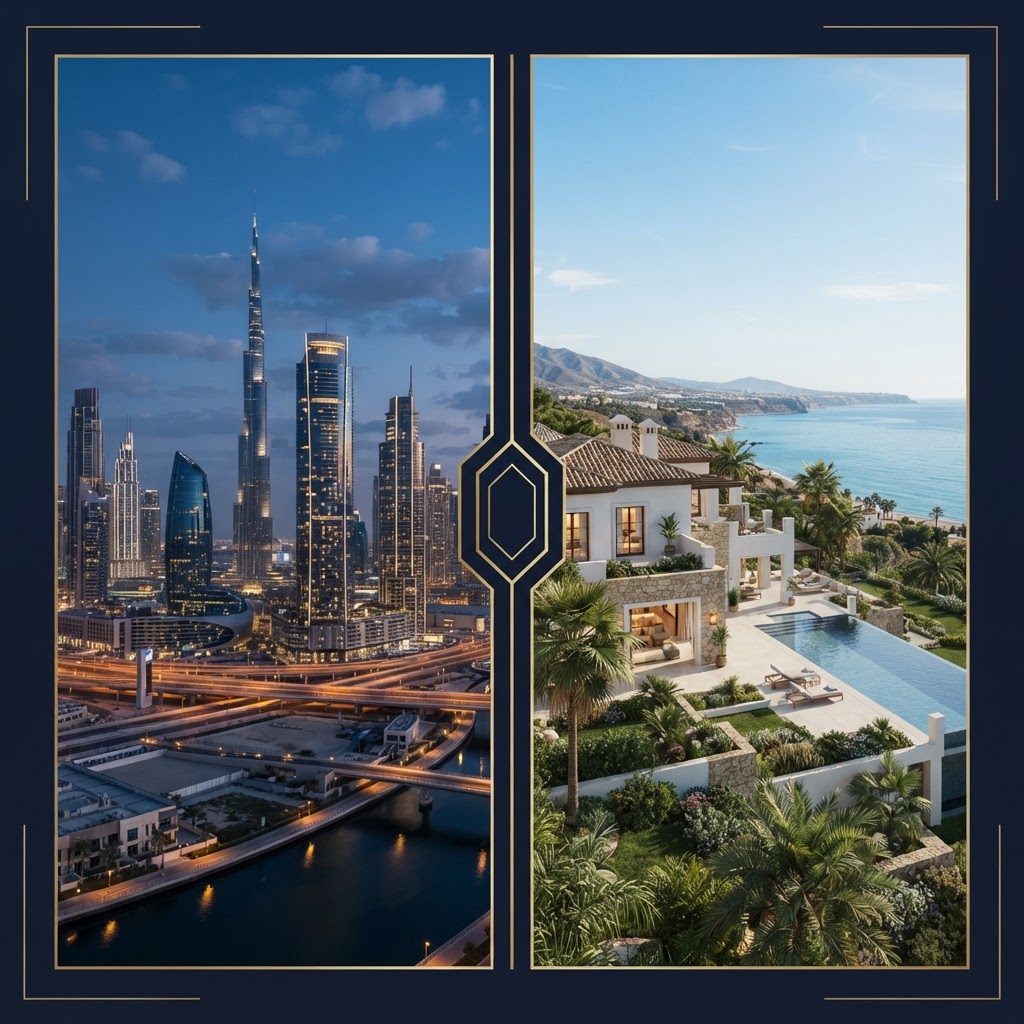
Global Branded Residences Weekly: Marbella's Fashion-House Wave, Dubai's Brand Blitz, and the Caribbean's Next Tier — Week 39, 2026
Share
Savills counts 910 branded-residence schemes worldwide with 837 more contracted through 2032. This week we track the six markets shaping the next wave: Spain's Costa del Sol fashion-house pipeline, Dubai's brand-density surge, the Caribbean's hospitality-led expansion, Montenegro's emerging Adriatic corridor, Portugal's Lisbon-led arrival, and Mexico's accelerated pipeline.
The Global Picture: 910 Schemes and Counting
Savills' Branded Residences 2025/26 report puts the global sector at roughly 910 completed schemes by end-2025, up 19% year-on-year and nearly triple the 323 that existed in 2015. A further 837 schemes are contracted through 2032. The average price premium over comparable non-branded inventory sits near 33%, with Knight Frank's parallel survey placing the range at 20-35%.
The category is also widening beyond hospitality. Nineteen new non-hotel brands entered in 2025 — fashion houses, an automaker, a 262-year-old crystal maison — against 39 new hotel brands. Three genuinely new categories (media, music, and art) entered for the first time, with Elle, Pharrell Williams, and the Louvre cited as early movers. The buyer diligence question has shifted accordingly: not just what the premium buys, but who is contracted to run the service program after the sales gallery closes.
Middle East and North Africa branded supply grew 187% over five years, Asia-Pacific 55%. Dubai remains the most visible single market for brand density; Marbella is the fastest-growing Mediterranean cluster. Below, we track the six markets that define this week's pipeline.
Spain: Marbella's Unprecedented Fashion-House Pipeline
Marbella has assembled something no other Mediterranean luxury market has built at this density in this window. The coastline between San Pedro and Las Chapas now carries more branded-residence stock per kilometre than anywhere along the French Riviera, and the implications for the established Golden Mile and Sierra Blanca resale markets are already visible in pricing.
EPIC Marbella by Fendi Casa — 56 residences on the Golden Mile, delivered by Sierra Blanca Estates. Now live in resale, it functions as the benchmark for how branded living performs once keys are handed over rather than how it presents in a brochure.
Design Hills by Dolce & Gabbana — 92 residences across five buildings on the upper Golden Mile, the last major undeveloped plot in the catchment. Sierra Blanca Estates develops; first deliveries scheduled for 2026, entry pricing from approximately 4.975 million euros. Fully furnished by D&G Casa.
Karl Lagerfeld Villas — five villas only, broken ground October 2022, under construction through 2026. First villa already reported sold. Extreme scarcity and architectural theatre at the opposite end of the Sierra Blanca portfolio from Design Hills.
Tierra Viva by Automobili Lamborghini — 53 villas in Benahavís (Zafiro, Esmeralda, and Diamond designs), prices from 3.6 to 8.4 million euros. Dar Global develops; Lamborghini's first European residential project; first-phase completion targeted mid-2026.
St. Regis Residences at Finca Cortesín — 46 residences in Casares, under construction, bringing full Marriott luxury-tier service infrastructure to the resort. Marea by Missoni, 65 residences on the same masterplan, runs at a more accessible entry point.
AÍDA by Bentley Home — eight duplexes near Puente Romano. Ocho de Oro by Versace Home — eight villas in Nueva Andalucía, pre-construction, the first branded project in the Golf Valley. Elie Saab Villas — five hillside villas in Sierra Blanca/Camoján, under construction.
Angsana Real de La Quinta brings Banyan Tree Group's hotel-and-residence model into the Benahavís masterplan, completion due 2026. The Waldorf Astoria Marbella moves forward via Higuerón Marbella Golf Resort as the brand's first Spanish property.
One project warrants caution: the long-running W Marbella scheme in Las Chapas received an urbanisation licence in May 2026 for a 160,000-square-metre beachfront plot (120 hotel keys, up to 166 residences), but reporting suggests the W association is no longer confirmed and the final operator has yet to be announced.
Three structural effects are already visible in the Marbella resale market: calibration (new buyers pricing established stock against branded launch prices), supply concentration (branded product clustering in Golden Mile, Sierra Blanca, and the Casares-Benahavís corridor), and the reputational shift that places Marbella alongside Cap d'Antibes and Porto Cervo rather than below them.
Dubai: Brand Density at Unprecedented Scale
Dubai's branded-residence pipeline through 2026-2031 is the deepest of any single market. Key projects currently in off-plan sales:
- Burj Binghatti (Jacob & Co) — Business Bay, Q2 2026 handover, AED 6.9M-175M
- Binghatti Mercedes-Benz Places — Downtown Dubai, Q4 2026, AED 9M-50M
- Sofitel Residence — Downtown Dubai, Azha Development, Q4 2026, AED 2.5M-22M
- Four Seasons Residence — DIFC, H&H Development, Q1 2027, from AED 23M+
- Fairmont Residences — Downtown Dubai, SOL Properties, Q3 2027, AED 2.9M-117M
- Karl Lagerfeld Villas — Nad Al Sheba, Taraf Holding, Q3 2027
New launches this quarter add further depth. JW Marriott branded residences by CG Developers on Dubai Islands mark the brand's first residential project in the UAE, starting from AED 2.37M. Hilton's first waterfront branded residences in the UAE launch at Dubai Maritime City, developed with Prestige One Development. The Residences at Sheraton Al Marjan Island by ATARA Development — the GCC's first Sheraton-branded residences — introduce waterfront wellness-led living to Ras Al Khaimah's emerging corridor.
BNW Developments, Ras Al Khaimah's largest private developer, debuted in Dubai this year with landmark branded residences, signalling that brand-led demand is pulling developers from neighbouring emirates into the Dubai market.
Dominican Republic: The Caribbean's Next Luxury Tier
The Dominican Republic is attracting serious branded-residence investment for the first time at scale. Banyan Group will establish its Caribbean footprint through Angsana Cap Cana and Cassia Punta Cana, both scheduled as part of the group's 2026 global expansion. Meliá Hotels International and Grupo Puntacana have joined forces on Paradisus Miches, the country's next luxury all-inclusive resort, continuing Meliá's aggressive Caribbean strategy.
Hyatt is entering with Hyatt Vivid Punta Cana, expected late 2026 — the first Hyatt Vivid branded resort in the Dominican Republic, an adults-only concept. On the ultra-luxury end, a proposed Punta Cana EDITION Hotel & Residences has been unveiled as a beachfront destination, though final confirmation is pending.
For investors, the Dominican Republic's appeal is dollarised rental income, lower entry values than established Caribbean markets, and a hospitality-led development story that is still early in its cycle.
Montenegro: The Adriatic's Emerging Branded Corridor
Montenegro's branded-residence market remains smaller than Spain's or Dubai's, but it is attracting international attention precisely because of its relative entry-value compared with saturated Mediterranean markets. Branded residences within Porto Montenegro are exceeding EUR 7,000 per square metre, with outer neighborhoods like Donja Lastva and Krasici offering more moderate alternatives.
The three primary branded hubs are Porto Montenegro (yachting culture, year-round marina energy), Luštica Bay (integrated resort town with golf, beach clubs, and family lifestyle), and Portonovi (newer luxury inventory with a wellness-led identity). Sotheby's International Realty Montenegro notes that buyers from the US, Western Europe, the Middle East, and Turkey place a premium on recognisable service standards when purchasing abroad — and branded residences answer that need.
The country's EU-candidate residency-by-investment programme adds a structural driver: property purchase can secure residency with a path toward full EU membership, making branded residences in marina communities a dual-purpose acquisition for international buyers.
Portugal: Lisbon's Branded Arrival
Portugal's luxury market is seeing the first wave of branded residences reach meaningful scale. Six Senses Lisbon is set to open in late 2026, spearheading a Portugal strategy focused on the shoulder season and wellness-led hospitality. The broader Lisbon Riviera and Comporta corridor is attracting Armani, Bulgari, and Four Seasons interest, with branded residences commanding a 20-30% premium over non-branded equivalents in the market.
Portugal's appeal rests on EU membership, the NHR tax regime's residual benefits for qualifying residents, and a lifestyle-tourism story that has moved beyond traditional accommodation into lifestyle hotels, branded residences, and hybrid models. Lisbon's prime residential market was among the strongest rental performers in Savills' H1 2026 World Cities Index, reinforcing the investment case for branded product in the capital.
Mexico: Accelerated Pipeline and Lifestyle Expansion
Mexico's branded-residence pipeline continues to deepen, driven by both international hotel groups and domestic operators. Kimpton expanded its Mexico presence with a new signing combining hotel and branded residences, while IHG Hotels & Resorts reinforced Mexico as its fifth-largest global market with a 184-room luxury hotel addition. Meliá Hotels International continues its Latin American footprint expansion through INNSiDE by Meliá openings.
The Mexican market benefits from proximity to US buyers, dollarised rental income in premium corridors (Punta Mita, Riviera Maya, Los Cabos), and a hospitality infrastructure that is mature enough to support branded-residence service standards. The trend mirrors the global shift: fashion and automotive brands are entering alongside traditional hotel operators, with buyers increasingly focused on who operates the service program rather than simply who licensed the name.
The Week's Takeaway
The branded-residences sector in 2026 is defined by three forces: geographic dispersal beyond traditional hubs (MENA +187%, the Caribbean's first tier, the Adriatic corridor), category widening past hotels (19 new non-hotel brands in 2025), and a maturing buyer who asks who runs the building, not just whose name is on it. For investors, the markets with the strongest combination of brand density, infrastructure, and entry-value remain Dubai for scale, Marbella for European premium, and the Dominican Republic and Montenegro for early-cycle positioning.
Data sourced from Savills Branded Residences 2025/26, Knight Frank 2025, Colliers, Sotheby's International Realty Montenegro, and project-specific announcements current to September 2026.